Reading history, today’s headlines, and predictions of the future, one could give up hope, believing humans will destroy each other. War after war, and stunning inequalities are the norm. But there have been great thinkers who wanted peace. Some made great strides toward that, and the developed world has made progress compared to earlier generations.
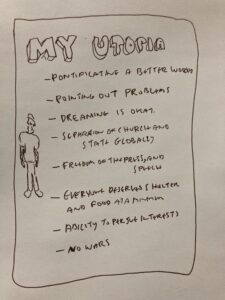
I’ve read many dystopian novels, and my work in progress is also dystopian. It’s kind of easy to think of bad routes humanity can go, so for this blog entry, I’ll write my vision of a utopia. And yes, I’m fully aware these are all unrealistic.
The first thing is the separation of church and state worldwide. The United States has had this since 1776, and it has created a diverse people with varying thoughts over the past three centuries. I understand that religion is beneficial on the personal level. AA and other addiction clinics have included religion, and it has made a difference. With grieving when family or friends pass away, many seek comfort from the religion they know. It also creates a connection with family and community.
Separation of church and state also means tolerance of different religions. When the church or other religious institutions are also the law, they push out other perspectives and thoughts. Religion can create an us-versus-them mentality. And throughout history, a lot of people died in the name of religion.
My second hope is that poverty ends. As technology improves food production and architecture, a goal should be that everyone has access to food and shelter at a bare minimum. In the United States, twelve percent live in poverty. For African Americans and Hispanics, it’s 20 percent. That is too high for the wealthiest country in the world. In other parts of the world that live under dictatorships, that percentage is higher.
There is a conservative ideal that everyone should work for what they get. As technology improves, is that really the case? The Rust Belt has seen robotics and production go overseas, which has severely shrunk the manufacturing sector. Every year, there’ll be more technological improvements to shift the workload from manual labor to robotics. The United States will also continue to exploit impoverished countries for cheap manual labor. Not everyone can excel in college, either. The percentage of people in the United States with a college degree is 37 percent, higher than it’s ever been, but not even close to most of the population. So, when manufacturing, agriculture, architecture, construction, retail, and most industries need fewer people in those fields, what happens to those work positions? It’ll be a decision humanity will have to make, and sooner than people may think.
In my view, I’d like to see more people being able to pursue what they want, whether it be sports, art, acting, music, or anything that interests a person. They always ask kids in school what they want to be when they grow up. I guess that the majority do something else rather than pursue their dreams. And with work, if someone is really into their career or wants to make a lot of money, that’s fine for them to work long hours. However, no one should have to work seven days a week behind a cashier to pay rent. People should have the opportunity to pursue what they want and not worry about survival.
Lastly, in my utopia, there’ll be no wars. I don’t follow the news enough to post my opinion on social media. Still, I wish Israel would stop the horrific bombardment of the Palestinians, and that Ukraine keeps its territory by defeating Russia. People should think as global citizens in the future, free to go anywhere in the world, and not with nationalistic mentalities. With basic needs met for everyone, humanity would not need war.